A weblog in English and Dutch about jazz and related music, record collecting and other music projects originally created by Hans Koert.|Een webblog in het Engels en het Nederlands over jazz, jazz-verwante muziek, platen verzamelen en verrassende projecten, oorspronkelijk opgezet door Hans Koert.
Milton "Milt" Herth (1902-1969) is considered a pioneer of the electric Hammond organ, he was in fact one of the first to play and record this novelty instrument shortly after it was introduced to the public in 1935. Herth's professional career started in 1935 when he was hired to play the Hammond organ at a radio station. In 1936, he signed a recording contract with Decca and made several records as a soloist that year showcasting the Hammond organ as a suitable instrument for performance of swing jazz.
Milt Herth - Stompin' At The Savoy (1936)
From the first issued Decca session recorded June 11, 1936, Milt Herth performed his solo version of Stompin' At The Savoy, also released at the Brunswick disc shown above
This version of Stompin' At The Savoy is famous for being the first ever recording of the electric Hammond organ issued on a 78 rpm disc.
Willie 'The Lion' Smith
In 1937, Herth began to work with jazz pianist Willie "The Lion" Smith in Chicago, when Smith also signed to Decca Records. Herth, Smith, and drummer O'Neil Spencer formed the Milt Herth Trio. The trio became a quartet with the addition of Teddy Bunn on guitar in April 1938.
O'Neil Spencer
From November 1937 to November 1938, Milt Herth recorded 26 sides for Decca featuring his Trio or Quartet. The first session with the trio was recorded November 11, 1937, two sides were cut and the first tune was Larry Clinton's The Dipsy Doodle with vocal by O'neil Spencer
January 7, 1938 Milt Herth Trio recorded the next session for Decca. Two sides were cut, an instrumental titled The Big Dipper and a version of Bei Mir Bist Du Shoen with vocal by O'Neil Spencer
September 13, 1938 the Milt Herth Trio recorded a great version of Duke Ellington's famous 1930 tune, Rockin' In Rhythm. In this session Frank Froeba replaces Willie 'The Lion' Smith on piano
Teddy Bunn
In April 1938, guitarist Teddy Bunn was added to the trio and he is featured in sessions with the Milt Herth Quartet from April 28 to November 30 that year contributing his unmistakeable and delicate guitar playing in tunes such as The Flat Foot Floogie, Shoot The Likker To Me, John Boy, Egyptian Ella, The Spider And The Fly and Jump Jump's Here
The above inserted few examples of recordings featuring the Milt Herth Trio and Quartet from 1937-8 are reissued on CD together with the remaining sessions from this period in the Cronogical Classics series devoted to Willie 'The Lion' Smith 1937-38, (CD 677)
Cronogial Classics, CD 677 - Willie 'The Lion' Smith (1937-1938)
Besides his recording career, Milt Herth also took part in several short films, a.o. Love and Onions (1935), Swing Styles (1939), and Jingle Belles, (1941) as well as the longer 1942 film, Juke Box Jenny, a movie noted for being a series of musical performances. - To end this small presentation of some of Milt Herth's best recordings from the late 1930s, I'll insert the YouTube version of the short film Jingle Belles. Go to 4:00 and enjoy a sequence featuring Milt Herth in performance at the Hammond organ
Georg Lankestergives his account of the background of a recently published new onlineOscar Alemándiscography.
Interesting
news for jazzguitar fans – a publication by Andrés “Tito” Liber
Oscar Alemán
The
Argentinian swing guitar legend Oscar Alemán (1909 – 1980) was for a
long time a somewhat neglected figure and in jazz reference literature hardly
presented in printed standard discographies - most likely – because much of his
recorded output was unavailable or hard to find outside Argentina
However, it is worthwhile to mention that Alemán
made several recordings in Europe
during the 1930s joining European and American jazz musicians in Paris while he
stayed in France as a member of Josephine Baker’s orchestra. This
small recorded output by Alemán (playing with jazzmen such as Freddy Taylor,
Bill Coleman, Alix Combelle, Danny Polo and others) may be known by
well-informed jazz fans of the European swing era and the recordings also have
been available on various long playing albums and later in CD format.
Charles
Delaunay
Alemán only recorded a few sides in his own name during his European
stay. Four sides were recorded by the French “Swing” label, established and
promoted by the secretary of the Hot Club of France, Charles
Delaunay.
Charles Delaunay
The
latter was one of the leading persons within this jazz organisation and he
introduced American jazz musicians to a European audience. Moreover he was also
the single most important figure to promote the gypsy guitarist Django
Reinhardt. In fact Delaunay was the originator of the famous “Quintette
du Hot Club de France” featuring Django Reinhardt and Stéphane Grappelli as star
soloists in a jazz setting formed by string instruments only. This was a
novelty jazz formation creating a hot swinging jazz sound never heard before and
the only original European pre-war contribution to the legacy of jazz in general.
Delaunay’s promotion of Reinhardt and the
quintet made it almost impossible for other jazz guitarists in Paris to
establish reputation and make records. And that’s the reason why the average jazz audience was mostly unaware
of Alemán being another brilliant jazz guitarist in town at the same high level
as Reinhardt.
Although Oscar was always overshadowed by
Reinhardt in the Parisian jazz scene, the
jazz critic Leonard Feather, who – in 1939 - wrote a much quoted review in the
“Melody Maker” on Oscar’s recordings, stressed that Alemán could ‘outswing’
Django and was a far superior jazzman .
Oscar Alemán in action - 1960s
Funny
enough Alemán and Reinhardt became friends with mutual respect for each other,
being ‘instrument brothers’ and they met from time to time. Late at night, when
each had finished work, muscians used to meet in certain Parisian places in
order to chat and play together. It is a fact that Django and Oscar
jammed together, but unfortunately those sessions were never recorded.
First
Dicographic info
Jazz Solography, vol. 4
The
European Alemán recordings are included in Brian Rust’s well-known reference
work “Jazz Records 1897 – 1942”as
well as in other standard discographies. In the
Seventies, the Norwegian jazz critic Jan Evensmo made a fair review of
Alemán’s European jazz records in one of
his publications in the “Jazz Solography” series.
Later
Evensmo, however, would resume his research of Alemán recordings and has
launched a new edition of his Alemán solography a few years ago which now
contains the Argentinian recorded output besides the European recordings,
available online, here
In the same decade (1970s) the TOM label
(“The Old Masters”) was launched in the US supported by enthousiastic jazz
collectors. Two LP albums were dedicated to Alemán, covering a selection of his recordings
from 1938-1957.
Oscar Alemán - Frémeaux CD (1994)
More
recent (in 1994) an Alemán cd was issued by the French Frémeaux label which
includes recordings from 1928-1943 with detailed liner notes. Further was the
TOM selection with additional material reissued on a double CD disc in 1997 by
Acoustic Disc.
The
basis of a complete Alemán Discograpy
It was Hans Koert, an acknowledged Dutch
jazz specialist and collector, highly
fascinated by Alemán’s work, who laid the foundation of a Discography as
complete as possible. During several years of thorough research he traced several Alemán records made outside Europe and he
even contacted the family of the guitarist in order to obtain more relevant
details.
Hans Koert's Tune-o-Graphy
In
2002 Hans published his Alemán “Tune-o-Graphy” (a printed version in English
& Spanish) realised in cooperation with Luis Contijoch. He resumed his Discography
research in 2004 which was finished in 2009 with a web log publication in 2006. Hans continued his immense study and further
published his work in a comprehensive and free accessible internet online Alemán Discographywhich he kept updated till he passed away in 2014.
On basis of the main data obtained by Hans
Koert, the Argentinian collector Andrés
‘Tito’ Liber - in cooperation with the present editor of Hans Koert’s website and blogs - added data and recently finished this update which is now
available on the Internet. An obstacle for the average visitor of Liber’s
online discography may be the Spanish
language, but serious users probably will cope with that.
This NEW
online discography by Andrés ‘Tito’
Liber is accessible by following the link in the sidebar at the weblog of
Hot Club de Boedo, here
Visit
this new online resource and discover more of the great swing guitarist Oscar Alemán - Online free accessible Oscar Alemán music, here
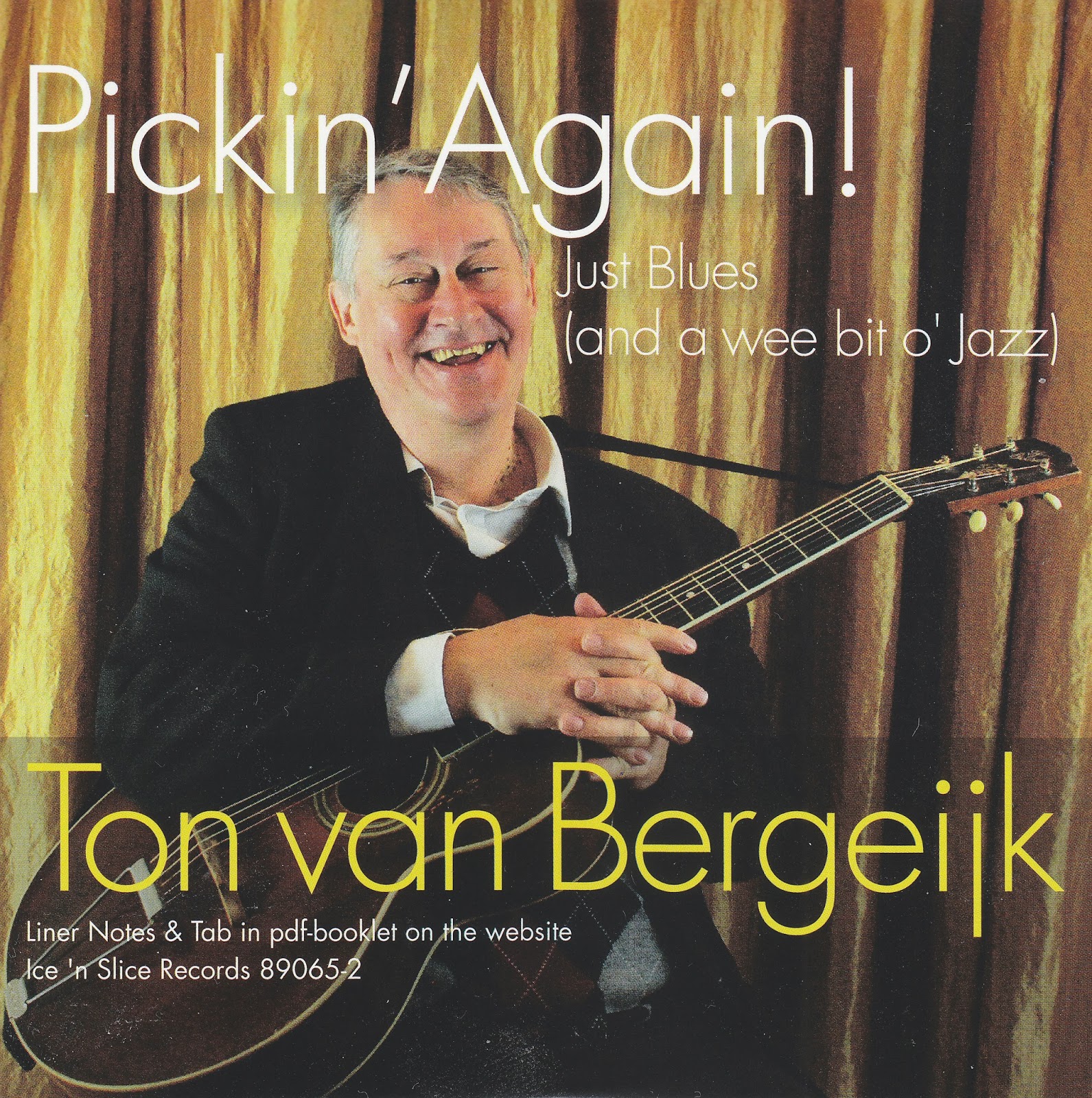
The Dutch guitarist, Ton van Bergeijk, has just released a new solo CD after almost 40 years of absence from recording solo fingerpicking guitar. The CD is produced by the artist, which means that everything from playing, recording, editing etc. is managed by Ton van Bergeijk himself. The CD is a highly welcome surprise for guitar fans who have long wanted to hear news from one of the best guitarists from the 1970s' rediscovery of the opportunities of the acoustic guitar when fingerpicked. In the liner notes, Ton states the background of the new CD, quote:
"Around '79 or so I did my last solo recordings. I hardly performed in those days. I had a regular job in systems programming, but after eight years it drove me physically as well as mentally over several edges, so by '83 I quit and tried to make a living by playing, safely, in the backline of several bands. Since then I have done a lot of different things: orchestras, bands, trio's, duo's, theatre, radio, television, studio's, the lot. Played and accompanied the whole caboodle, from Transylvanian fiddle tunes to free jazz, from the classics to New Orleans funk. Broadened my horizons, learned loads since my blues-based beginner days. All these influences have left their mark on my approach to fingerpicking. So now, like in Plato's cave, I'm returning to the scene of the crime with a different set of tools. Same brain, face and fingers, but a different guy, and if you think it isn't good any more: do have the courtesy to grant this pig his mud."
Ton van Bergeijk (photo courtesy tonvanbergeijk.nl)
The CD contains fourteen tracks of tunes composed and/or arranged by Ton van Bergeijk - a tracklist with additional info on how to buy the CD is available at the official website, here. As the subtitle of the CD indicates, the music is devoted to the blues genre and "... a wee bit o' jazz". To get a little closer to the kind of music presented at the CD, you will discover influence from both ragtime guitar pioneer Blind Blake, boogie woogie piano players, rhythm & blues a la Ray Charles and Aretha Franklin and further the funky approach of New Orleans king of the ivories James Booker combined with licks and tricks inspired by Nashwille's guitar 'wild man' Jerry Reed thrown in for good measure, a nice gumbo stew which bears all the trademarks of Ton van Bergeijk's amazing ability to arrange and play great music as a highly gifted fingerstyle guitarist.
CD disc, Ice 'n Slice Records 89065-2
A couple of more quotes from Ton's comprehensive notes with the CD may help the reader of this short review to further imagine the amount of experience and work which is the background of the presented music.
About his inspiration as a guitar player, Ton says: "I've always been interested in the blues and jazz guitarists of the interbellum period, but in a way that would provide me with fantasies of how they thought about their guitar, whether these fantasies were true to reality or not. That way you can use their "guitar-brains" to your own advantage." And about piano inspiration, he adds " I have always been influenced by pianists, maybe more so than by guitarists. Especially New Orleans guys like [James] Booker or [Mac] Rebennack [aka Dr. John]: they've always made the connection for me with classic jazz and therefore effectively opened my window towards post war rhythm & blues. The New Orleans piano styles in my mind have the quality of being chord-based rather than scale-based, which makes it more adaptable to guitar interpretations ..."
This is valuable information for other guitarists with interest in studying Ton's approach and the recorded tunes, which in addition have been transcribed in tablature and regular music notation in the accompanying booklet. Later the recorded tunes will be followed by some video lessons to let other guitarists have the opportunity to further study the music and the amazing technique applied by this Dutch wizard of the contemporary fingerpicking guitar. Learn more about the CD and the future project of video lessons by visiting the official website, here
Ton van Bergeijk (photo courtesy www.tonvanbergeijk.nl)
Georg Lankester writes a review of some recordings recently added to his collection reflecting the influence of Django Reinhardt - past and present.
An Old Django Recording From His Musette Years
Last March I spent a weekend in Belgium to visit the beautiful town of Antwerp and to meet a very good Django friend. Together we went to a huge cd & book department in the branch of the French “Fnac” company, with headquarters in Paris. Looking around I happened to find a Double CD dedicated to the Parisian Musette with many interesting tracks of different artists from the past.
CD box: Accordion Paris Musette, CD RETRO 2007- 2x 618
To my surprise one of the CDs included a track of the former accordionist Vetese Guérino, accompanied by guitarist Django Reinhardt.
The legendary accordionist Vetese Guérino
Accordionst Guérino was a popular artist in Paris in the Twenties and Thirties and his orchestra was called La boîte à matelots(sailors’box). Both Django ReinhardtandBaro Ferret joined this band (and often Gusti Malha) of which some recordings were made.
La boîte à matelots
The featured title on this CD is Gallito - a paso double – which was recorded in 1933 with Django now on guitar, so some years after the fire accident. Guérino already asked Django in his band around 1925 because of his special banjo technique which was far different than all other players. I could add to this that, in the early Thirties, Django usually travelled to Toulon in summertime and also there performed with Guérino in 1931. A nice experience to find such a recording which brings back memories of the heydays of the Musette. - You have the opportunity to listen to Gallito in the YouTube audio-video below as the first track from the uploaded disc 2 of the box-set mentioned above.
Great Guitar Playing, For ‘Gypsy Swing’ Fans And Others
For more than 50 years I am fascinated by the music of Django Reinhardt and I have seen and heard lots of artists playing in the style which he created. Most of what they recorded forms part of my collection and here is another item that certainly can be added.
Stunt Records, CD STUCD 15162
The Schmitt family from the Alsace is well-known, because several of its members got worldwide reputation as guitar virtuosos, in particular the brothers Tchavelo and Dorado. The latter’s son, Amati - who is also playing in the Django tradition – now joins his father’s quintet and together they travel throughout Europe in order to give concerts. One of their concerts took place in Denmark, in the city of Fredericia where they joined the Winter Festival in 2014. And….then something particular occurred.
Dorado & Amati Schmitt Group
After their concert, when the audience had left, a series of recordings were made for the Stunt Records label. A great initiative. The result is the CD Sinti du Monde which includes 11 titles and here is my first impression.
Right from the start, backed by an easy swinging rhythm group, Dorado plays the lovely melody of Rose Room like Django did in the Thirties (though the sound of the guitar is a bit different). His solo is inventive and includes fast runs, but it is never too far off the theme. And so he continues the other ten tracks, always showing control over his instrument, improvising whatever the rhythm is. In his composition For Francko, Dorado adds some vocals and the Ballade Romanez (another own piece) is impressive with a solo of great beauty. Next to a few nice bossa themes Dorado also can be heard on violin in the Waltz for Esben - a homage to the Danish producer of the CD. Again it shows that he masters this instrument while bringing beautiful improvisations.
It is not my intention to describe all tracks. Django fans should discover that themselves. Tracklist include these titles: Rose room, Stompin’at the Savoy, For Francko, Ballade Romanez, Gloria forever, Waltz for Esben, After you’ve gone, Je suis seul ce-soir, How high the moon, Hayo Cue Cae, My blue heaven. - More info at the website of Stunt Records, here. Official website of Dorado Schmitt, here
To end this review, I found a couple of YouTube videos featuring Dorado and Amati Schmitt Quintette recorded live in Denmark earlier this year - enjoy!
Swing emerged with the rise of big bands mid-1930s in the USA, and while the music of orchestras led by Jimmie Lunceford, Cab Calloway, Fletcher Henderson, Benny Goodman, Tommy and Jimmy Dorsey, Artie Shaw, Woody Herman, Glenn Miller and many others is still played today and appreciated by swing music fans, a then popular band co-led by songwriter/arranger Will Hudson (1908-1981) and songwriter/vocalist Eddie DeLange (1904-1949) - The Hudson-DeLange Orchestra - is almost forgotten by contemporary big band swing enthusiasts. The reason for this unfair treatment of some great music may partly depend on the short lived existence of the Hudson-DeLange Orchestra and further on the sad fact that the music of the band has not been reissued on CD - only a much searched after LP by collectors released by Bandstand Records (BSR 7105) seems to have reissued and presented some of the recordings by the orchestra since the original 78 rpm discs were in the market.
LP front: Sophisticated Swing of The Hudson-DeLange Orchestra (1936-1939)
Will Hudson
Will Hudson put together his first big band in the ‘30s in Detroit, but in 1935 he teamed with Eddie De Lange and formed the Hudson-DeLange Orchestra which made several recordings for the Brunswick label. He was active as an arranger for several of the top bandleaders of the day such as Cab Calloway and McKinney’s Cotton Pickers. He also wrote for Fletcher Henderson, who recorded his Hocus Pocus in 1934, and Jimmie Lunceford, who took Hudson’s instrumental, Organ Grinder’s Swing to number two on the charts in 1936. Hudson’s Sophisticated Swing with lyrics by Mitchell Parrish was recorded by several bands in 1938, including Woody Herman’s. The songwriting duo of Hudson and DeLange has one of the finest standards to its credit, Moonglow, written in 1934. It was published by Irving Mills who is also credited, as many publishers were then, with contributing to its origin. (info excerpted from this source)
Eddie DeLange
Eddie De Lange came from a musical family, but he began his career as a stunt man in Hollywood movies. When he returned to New York City in 1932 he worked as a lyricist for the music publishing company of Irving Mills and collaborated on The Man with the Horn (with Jack Jenney, 1932); Haunting Me (with Joseph Myrow, 1934); and two enduring standards, Moonglow (with Will Hudson and Irving Mills, 1934) and Solitude (with Duke Ellington, 1935). From 1935 to 1938 he and Will Hudson led one of the early swing bands and recorded for the Brunswick label. The band was extremely popular and played hundreds of engagements in the best venues around USA. (info excerpted from this souurce)
The Hudson-DeLange Orchestra
With the Hudson-DeLange Orchestra, much of the time DeLange led the band and Hudson stayed behind the scenes. The group appeared principally in eastern colleges, ballrooms, and hotels; it is reported on DeLange's official website that from 1936-38 they played over 200 ballroom dates throughout New England and the Midwest, as well as the Terrace Room of the New Yorker Hotel. Among the sidemen in the band were, at various times, Steve Lipkins (trumpet), Gus Bivona (clarinet and alto saxophone), Bus Etri (guitar), Doc Goldberg (bass), and Billy Exner (drums). But in early 1938, Hudson and DeLange decided to go their separate ways. Hudson continued on the road with a group under his own name. Eddie DeLange formed and led his own orchestra on several tours, a chance meeting with composer, Jimmy Van Heusen, resulted in a highly productive partnership which a.o. produced Deep In A Dream (1938). They had their biggest hit with Darn That Dream (1939). (info excerpted from this source)
Between 1935 and 1938, the Hudson-DeLange Orchestra, even with its extensive tour schedules, recorded more than 50 songs for Brunswick Records, many of them original compositions. Below I'll insert some examples which have been uploaded at YouTube, Here is first The Hudson-DeLange Orchestra's version of Will Hudson's Organ Grinder's Swing recorded March 20, 1936
Next video features the band's version of Bugle Call Rag recorded March 10, 1937
This recording of Bugle Call Rag was among the first which caught my attention thanks to the guitar solo by Bus Etri, the legendary guitarist best known from recordings with Charlie Barnet's orchestra. Bus Etri's contribution to big band swing is much underrepresented, however, there are three more remarkable solos with the Hudson-DeLange Orchestra presented at the Bandstand LP mentioned above. Great solo work is featured in Stardust (also recorded March 10, 1937), On The Alamo (April 8, 1938) and Hangover In Hong Kong (June 10, 1938).
Swing guitar legend Bus Etri and unknown (b)
Will Hudson's composition Sophisticated Swing was recorded March 11, 1937 issued on 78rpm: Master 103 & Brunswick 7991
On December 20 1937 the Hudson-DeLange Orchestra recorded Definition of Swing issued on 78rpm: Brunswick 8071
To end this small presentation of a great swing big band, here is Hudson-DeLange's version of the well known standard On The Alamo recorded April 8, 1938 and issued on Brunswick 8156
A couple of days ago I found out that the account for the Oscar Alemán website including Hans Koert's original OAonline dicopgraphy a.o. hosted at opweb.nl is suspended (see previous blog entry). Unfortunately, I have not access to this account, thus, a renewal is out of my hands. Things are a bit complicated, as Hans Koert did not provide me with info how to handle a situation like this, and I now regret that I never asked, before it was too late. However, Hans Koert had a back-up of the online OA Discography uploaded at a local net-server, fortunately this version of the discography still works at my computer. Here is the link.
I cannot assure that the link works outside Europe/EUC and I would appreciate to have feed-back from readers of other regions/countries to clarify, if the mentioned link is accessible at their locations.
Visitors can contact me by using the e-mail stated below.
Until I have worked out an updated version of Hans Koert's online Oscar Alemán Discography, which may take some time, researchers of Alemán's recorded legacy have access to the latest updated info by visiting the recently published OA discography by Andrés 'Tito' Liber hosted at the weblog of Hot Club de Boedo, here
Everything concerning Hans Koert's El Redescubrimiento de Oscar Alemán /The Rediscovery of Oscar Alemán project including the online OA Discography created by HK has suddenly vanished from the web, visitors have the following message:
*"This account has been suspended. Either the domain has been overused, or the reseller ran out of resources."
Further, as a consequence of the suspended account the following of HKs work is also no longer available online:
Hit of The Week Discography, Durium Advertisement and Custom Records Discography, Durium (GB) Discography, the link site (Survey) and HKs Articles index including uploaded pdf files.
Visitors get this message:
"Not Found - The requested URL /how.htm was not found on this server. Additionally, a 404 Not Found error was encountered while trying to use an ErrorDocument to handle the request. Apache/2 Server at www.durium.opweb.nl Port 80"
Until I find out what has happened to the mentioned websites, all further activity at the weblogs associated with the keepitswinging.doman is suspended.


 Retrospect
Keep Swinging (old)
Oscar Aleman Choro Music Flexible Records Hit of the Week-Durium Friends of the Keep Swinging blog Keep Swinging Contributions
Retrospect
Keep Swinging (old)
Oscar Aleman Choro Music Flexible Records Hit of the Week-Durium Friends of the Keep Swinging blog Keep Swinging Contributions