Showing posts with label Les Loups. Show all posts

Tuesday, September 29, 2015

The Recording Debut of Les Loups

Original ad illustration by VICTOR TALKING COMPANY (courtesy by Erik Host)
From the online discography of Oscar Alemán we only have an approximate date of the recording debut of Les Loups. The info stated in the online discography gives c. December 10th, 1927 as the date of the recording of the tango-milonga 'Hawayanita' and the waltz 'Criollita' by Les Loups, the recording debut by the duo for Victor, issued on Victor 79968.
Victor 79968-A
Another source, the online Discography of American Historic Recordings, states the recording date of Victor 79968 as 'Winter 1928' for the catalog numbers of the mentioned tunes, BAVE-1588 and BAVE-1589.
AHR Discography detail (click to enlarge)
Further info in the online AHR discograpy states that take 2 of both matrix number BAVE-1588 and BAVE-1589 were used as masters for the issued Victor 79968 disc - here is the info for BAVE-1588 inserted below
AHR Discography detail (click to enlarge)
Last week I had a mail from Anthony Baldwin, who now can confirm the precise date of the recoding debut of Les Loups as December 6th 1927 and further has some interesting info that I like to share here. I quote Mr. Baldwin below by permission, the inserted scans are also forwarded by this observant collector.
HMV R14030 (scan courtesy by Anthony Baldwin)
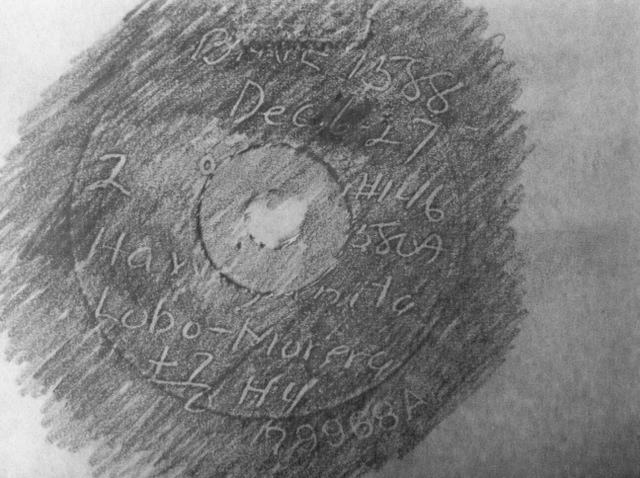
Anthony Baldwin writes: "I recently acquired HMV R14030, the Italian issue of Argentine Victor 79968: Hawayanita (BA1588) and Criollita (BA1589). Under the label of the Hawayanita side there is legible information scratched in the original wax by the engineer, notably the matrix number "BAVE 1588" and a precise recording date "Dec. 6..27".
Copy of original wax info at HMV R14030 - Hawayanita (courtesy by Anthony Baldwin)
"The "Hawayanita" side has legible matrix information scratched in the wax under the label, clearly dating the session to "Dec. 6. 27", whereas the date on the Oscar blog is "c. 10 December 1927". There is also a hand-inscribed "2" at 9 o'clock from the spindle hole, which would appear to confirm the die-stamped take number "2" in the wax run-off area. The flip side, "Criolitta", also bears the take number "2" in the run-off."

"In my view, c. 10 December 1927 was always a slightly dubious estimate, mainly because the 10th was a Saturday, a day when — in western culture, at least — musicians are usually busy working elsewhere. For similar reasons, the probably American engineer at Argentine Victor would have been used to the U.S. practice of working Monday to Friday: Saturday was for the racetrack or the golf course. Unless someone like Rachmaninov had been in town, I doubt that the engineer would have been amused to be dragged into the studio at the weekend — and certainly not for a couple of obscure guitarists!"

"It's interesting that the artist credit scratched in the wax is not to "Les Loups", but to Lobo-Morera [sic], presumably because Oscar was using his father's name, Moreira."

My comment regarding the last mentioned is that published sheet music from the period often credited Alemán by writing 'Oscar M. Alemán' - the 'M' could refer to his father's name, however, Oscar's middle name was another possibility. His full name actually read 'Oscar Marcelo Alemán'.
Sheet music frontpage - Hawayanita
Mr. Baldwin adds another interesting detail regarding the Victor session on Dec. 6th, 1927:
"Interestingly, the two matrix numbers immediately preceding the "Hawayanita" session, BAVE 1586 ("Caxorro") and 1587 ("Ya...Ya"), are by the Elio Rietti Jazz Band, apparently also recorded on Dec. 6, 1927. These sides are also both take-2. One wonders whether there was any connection between the Rietti band and Les Loups, or whether they were simply booked into the studio on the same day."

If someone can supply enlightening information of a possible connection between Les Loups and the Elio Rietti Jazz Band - a very popular and pioneering jazz band in Argentina in the 1920s, I should like to learn more. Contact me by using the e-mail below. Or use the comment facility of the blog.

Thanks a lot to Mr. Anthony Baldwin for his very informative observations!
---
Jo
keepitswinging.domain@gmail.com


Retrospect Keep Swinging (old) Oscar Aleman Choro Music Flexible Records Hit of the Week-Durium Friends of the Keep Swinging blog Keep Swinging Contributions

Wednesday, July 29, 2015

Harry Flem(m)ing - Recordings Made In Milan 1933 & 1938

Hans Koert earlier published a definitive and well researched article about Oscar Alemán's engagement with entrepeneur and band leader Harry Flem(m)ing during the period when Les Loups were a part of Flem(m)ing's revue in Europe 1930-31 - the article is to be found here. In his article Hans Koert refers to the sources of his research and a.o points to an article written by the German researcher and writer on jazz and related topics, Rainer Lotz, who in collaboration with Horst Bergmeier has written a very detailed account on the adventures of Harry Flem(m)ing's career in Europe. The article is from 2007 and has the title Harry Fleming - „Der Dandy aus Harlem”, written in the German language (Dietramszell, Fox auf 78, 24, Sommer 2007, pp.32-39). I have a copy of this article as a Word-document, which I recently read again and took notice of some info that I should like to share here. It's about the period after Oscar Alemán's break with Harry Flem(m)ing in 1931 and the focus here is especially on the recordings made by Harry Flem(m)ing in 1933 and 1938, as I was astonished to learn that there in fact exists recorded audio credited to this almost mythical figure. I got curious and looked up the info shown below in Tom Lord's discography

Extract of Tom Lord's discography (Version 9.0), click to enlarge
Both 1932 and 1933 Harry Flem(m)ing had long engagements in Italy with performance all over the country featuring a troupe of musicians, dancers and entertainers in a new constellation of his revue show. According to the info in the mentioned Lotz/Bergmeier article the accompanying orchestra in 1933 had an international crew featuring seven or eight Italians, four Americans, three Englishmen, two Spaniards and a German, however, none of the names mentioned in the article seem to have participated in the recordings made for Columbia in the fall of 1933, if you compare with the info stated in Tom Lord's discographical listing (see above). Lotz/Bergmeier further state that 10 sides were recorded for Columbia in Milan 1933 while Lord only lists 8 sides, and the article also adds more precise info regarding the dates. The recordings were done in two sessions, the first one took place on 21. October and the second on November 1st. Lotz/Bergmeier futher mention that the two titles on Co CQ. 1328 were recorded on the 21st of October, but have no detailed info regarding the remaining titles. The Co CQ. 1328 also seems to be the most interesting disc, as it features Harry Flem(m)ing on one side as a singer and tap dancer in 'Dixie'. - The audio of this recording has been uploaded at YouTube and is inserted here


Tom Lord's listing of personnel participating in the 1933 Columbia session(s) probably is incorrect, for instance it is not possible that Albert Wynn (tb) took part in the recordings, as he had left Flem(m)ing's troupe in 1932 and went back to the US where he for some time was a member of Sidney Bechet's N.O. Feetwarmers and also recorded with Bechet that year. However, Lord's info on personnel of the 1933 recordings is stated as 'probably', but it is misleading regarding the two sessions that were recorded by „Harry Flemming e la sua Orchestra“ in 1938. According to Lotz/Bergmeier, Flem(m)ing's orchestra again recorded two sessions for Columbia in Milan 1938 during another tour of Italy. 

The first session was recorded on the 2nd March and issued on two 78 rpm discs, Co DQ.2617 and DQ. 2618 as listed by Tom Lord. The second session was recorded a month later on the 2nd April and the two titles from this session were issued on Co DQ.2637. Tom Lord's info on personnel participating in the two 1938 sessions is misleading, as it lists the personnel as 'probably similar' to the 1933 sessions, but with the additon of a featured vocal by Nada Villefleur on some of the 1938 recordings. Lotz/Bergmeier have a detailed listing that comprises Italian musicians only. They are as follows for the March 2nd session: Pippo Renna, Loreto Ficorilli (tp), Giacomo Polverino (tb); Piero Rizza (as, cl), Francesco Paolo Ricci (cl, as, bar s), Alberto Spallazzi (ts); -- Parisi (p); Cosimo di Ceglie (g); unknown (b), Lello Mauceri (dm) - on the April 2nd session Nello Digeronimo (tb) replaces Giacomo Polverino and Nada Villefleur is added as vocalist. According to Tom Lord's info Nada Villefleur is added vocalist on 'Stompin' At The Savoy', but the audio of the recording does not feature a vocal. The audio of this recording of Stompin' At The Savoy (NB mislabeled as 'Stampin' At The Savoy' on the issued 78 rpm disc) has also been uploaded at YouTube and is inserted below to end this

---
Jo
keepitswinging.domain@gmail.com

Retrospect Keep Swinging (old) Oscar Aleman Choro Music Flexible Records Hit of the Week-Durium Friends of the Keep Swinging blog Keep Swinging Contributions

Friday, May 1, 2015

Les Loups Revisited

Les Loups ( original photo courtesy by Erik Host)
Oscar Alemán teamed with Brazilian guitarist Gastón Bueno Lobo c.1925, they formed a duo that was named Os Lobos (- indicating G.B. Lobo's primacy of the duo), later the Portuguese word was changed into Les Loups.The duo had its professional debut in Rio de Janeiro 1926 (- more info, here), they were billed as Hawaiian guitarists and were featured in various performances together with other artists at different venues and even were presented in a live radio program. The debut of the duo was a success with the Carioca public and was followed by a short tour of Brazil early 1927. Later that year Les Loups were brought to Buenos Aires after joining Argentinian comedian Pablo Palitos, who introduced the duo in Buenos Aires and helped arranging exposure of Les Loups. The duo performed in various venues in Buenos Aires, was presented in radio and finally had the important luck of signing a recording contract with the prestigious Victor label. From December 1927 to December 1928 Les Loups recorded 16 sides for Victor as a duo and featuring violinist Elvino Vardaro as Trio Victor they recorded 8 sides more in this formation from September 1928 to January 1929 (- discographical details are available at Hans Koert's indispensable online discography, here).

The 16 duet recordings of Les Loups for Victor are the debut on record of Oscar Alemán, but this chapter of Alemán's career has mostly been neglected by critics and historians, who have engaged in Alemán's career and recorded output. Critics still seem to categorize Alemán as just another jazz guitarist and a clone of the Django Reinhardt 'school' of swing. But this was not the way it started, as Les Loups performed as Hawaiian guitarists and took advantage of the 'Hawaiian' hype that swept the world in the early decades of the last century.

The musical repertoire of Les Loups comprised tangos, waltzes and a few fox-trots performed in the 'Hawaiian' way, which means that the melody is played using a slide or steel bar by the lead guitarist while the other guitarist provides elaborate accompaniment using the insturment in a conventional way playing chords, fill ins etc. and supporting the rhythm. G.B. Lobo had the leading role playing the melody with a steel bar while Alemán provided supporting accompaniment. The Victor recordings by the duo are magnificent examples of a great teamwork and interplay between the two guitarists, and it's a shame that these recordings never have been re-issued - maybe that's a part of the background for neglecting this division of Alemán's recorded output by most critics?

Among the recorded tunes by Les Loups the famous tango 'La Cumparsita' (- recorded August 1928) had its debut on record in the version by the duo. Another famous, early tango was 'Guitarra que llora' that was composed by G.B. Lobo (- and elaborated in partnership with Alemán). This tango was recorded by Les Loups c. May 2nd 1928 and issued on a Victor 78' rpm disc (Victor 80839, mx BAVE- 44058A-2)

Victor 80839-A, Guitarra que llora
The audio of the Victor recording of 'Guitarra que llora' has been uploaded at YouTube and is inserted here to give you an impression of the great interplay between Lobo and Alemán


This was the initial recording of 'Guitarra que llora', but other artists also recorded this tango by G.B. Lobo and Oscar Alemán after it had added lyrics by Enrique Cadícamo and was published as sheet music

Original sheet music frontpage
A contemporary of Les Loups was tango singer Augustin Magaldi, who recorded his vocal version of 'Guitarra que llora' for Victor shortly after the initial recording by Les Loups.

Augustin Magaldi
It has earlier been assumed by tango discographers that Magaldi's recording of 'Guitarra que llora' had featured Les Loups as accompanying guitarists, as the recording was made on a date when Les Loups also happend to be in Victor's studio in Buenos Aires (August 25th, 1928), but this assumption cannot be confirmed neither by audible review nor by available info in Victor's files (- a discussion regarding this a.o. is available here). Most likely the accompanying guitarists with Magaldi's vocal are his regular accompanying guitarists in 1928, Diego Centeno and Ángel Domingo Riverol. Anyway, here's Magaldi's version of 'Guitarra que llora'


By coincidence I found a recently recorded version of 'Guitarra que llora' uploaded at YouTube and performed by a Belgian trio named Les guitares magiques. This contemporary version revisits the original version by Les Loups and is a magnificent re-take of the tune that generates a hope for more from this talented Belgian trio. It's a sheer joy to learn that contemporary musicians finally have experienced the lasting quality of the music originally recorded by Les Loups.

Les guitares magiques (YouTube)
I have not much info about Les guitares magiques, but here are a few details extracted from the info added with another uploaded video by the trio: "Slide masters Raf “Lazy Horse” Timmermans and Gijs Hollebosch usually accompany singer-songwriters. They met in early 2012 and gigged together a few times. Soon it became clear they had to share their passion for slide music. Digging deep into the Hawaiian style of playing slide guitar, Raf and Gijs soon discovered a whole unexplored world of forgotten music. Together with double bass player René Stock they built a new repertoire. It is Hawaiian, but it is also much more." 

Enjoy 'Guitarra que llora' as played by Les guitares magiques from Belgium, a great tribute to the original recording of the tango as played by Les Loups in 1928


---
Jo
keepitswinging.domain@gmail.com


Retrospect Keep Swinging (old) Oscar Aleman Choro Music Flexible Records Hit of the Week-Durium Friends of the Keep Swinging blog Keep Swinging Contributions

Thursday, September 19, 2013

O.A. 1926

O.A. 1926 : Vroege Oscar Aleman compositie opnieuw in schijnwerper
Jørgen Larsen  (vertaling: Hans Koert)

Oscar Alemán leerde zichzelf spelen op de cavaquinho - een viersnarige Braziliaanse ukulele, waarmee hij in de straten van Sao Paulo aan de kost probeerde te komen door muziek te maken ....  Hij was toen één van die honderden kansloze zwerfjongeren die de straten van Zuid-Amerika bevolkten. In 1924 ontmoette hij de Braziliaanse gitarist Gastón Bueno Lobo, waarmee hij een duo vormde, genaamd Les Loups, dat eind jaren twintig uitgroeide tot een populair succesvol duo met optredens in Rio de Janeiro en Buenos Aires. Begin jaren dertig reisden ze mee met de Harry Fleming Company naar Europa en maakten deel uit van zijn "varieté-show".


Les Loups stond op de affiches als Hawaiian guitarists en speelde tangos, walsjes, fox-trots en andersoortig licht amusement. In Buenos Aires had Les Loups  al een achttal 78-toerenplaten gemaakt voor Victor waaruit blijkt hoe talentvol dit duo was. Op de platen speelt Gaston Bueno Lobo de lead voice op een Hawaiian lap steel gitaar, terwijl Alemán op een "gewone" zessnarige gitaar begeleidt. 

Criollita - Les Loups (Victor 79968) ( opgenomen Buenos Aires 10 december 1927) ( bron: Oscar Aleman discography - Hans Koert) (Bolzan colección)

Op één opname echter, de B-kant van hun eerste plaat, speelt Gaston Bueno Lobo de cavaquinho in zijn eigen compositie "Criollita", een walsje; de Hawaiian lap steel gitaar wordt hier niet gebruikt. Dit is meteen de enige keer dat de cavaquinho gebruikt wordt in een opname van dit Hawaiian duo Les Loups, ook wel Los Lobos genaamd, en dat is eigenlijk vreemd als je bedenkt dat Oscar Alemán in die tijd voornamelijk cavaquinho speelde. Zijn eigen compositie O.A. 1926 ( O.A. schijnt niet Oscar Alemán, maar Oceáno Atlántico te betekenen - wie het weet mag het zeggen) is speciaal geschreven voor cavaquinho, maar werd niet door Les Loups op de plaat vastgelegd. Er zijn verschillende redenen voor te verzinnen, zoals bijvoorbeeld dat Victor dit ragtime-achtige nummer niet vond passen in haar repertoire en een andere reden zou kunnen zijn, dat Gaston Bueno Lobo, die als leider van het duo op de voorgrond trad, niet wilde dat Oscar Alemán soleerde.  Feit is dat "O.A. 1926" pas in 1972 werd
opgenomen als solonummer in een opnamesessie voor het label Redondel, dat het album Alemán '72 uitbracht. Luister maar eens hoe het nummer O.A. 1926 in 1972 klonk.


Oscar Alemán paste in zijn concerten, toen hij de ster was in Argentinië, graag zijn cavaquinho in, die hij bij zich had tijdens concerten en dan speelde hij O.A. 1926 solo op zijn cavaquiono als onderdeel van de show. Tot groot enthousiasme van het publiek overigens.  Er zijn verschillende van die solo-optredens van O.A. 1926 op privé-opnamen bewaard gebleven, zoals deze radio-opname uit 1955:


Het nummer "O.A.1926" werd maar zelden vastgelegd op plaat door andere artiesten. Een schitterende vertolking op ukulele is de solo-opname van onze eigen Nederlandse Wizard of the Strings, Ton van Bergeyk, nu banjoïst - gitarist bij de Dutch Swing College Band, die in 1976 voor Kicking Mule het  nummer 'Anno 1926', opnam. Zijn uitvoering ligt het dichtst bij die van Oscar Aleman zelf ....... Wie eens op een regenachtige zondagmiddag op YouTube gaat rondstruinen, vindt het nummer gespeeld door verschillende ukelele spelers, waarvan de versie van de Japanse Wizard on the Strings  Mario Takada, de interessantste is.  Luister maar eens naar zijn versie:


Mario Takada is één van de leden van Sweet Hollywaiians, een string quartet uit Osaka, Japan, gespecialiseerd in de stringmuziek, de hawaiian swing, calypso en zo meer uit de jaren twintig en dertig van de vorige eeuw. Sinds 2008 maakten ze vier cd's.  Ze verrasten me een paar jaar geleden met een grandioos concert in Belsele ( bij Sint-Niklaas) (België).  Op hun website vind je veel informatie.


The Sweet Hollywaiians ( in Belsele 2010) ( foto: Hans Koert)

Onlangs publiceerde de Sweet Hollywaiians een EP met  alleen nummers gewijd aan de ukelele, getiteld Magic Ukulele Waltz, waarop een aantal uitvoeringen, waarvan voor alle fans, die de vroege muziek van Oscar Alemán waarderen, de titels "O.A. 1926" and de Gaston Bueno Lobo wals "Criollita" wat ons betreft de show stelen ............ 


Deze CD is een must voor alle ukelelespelers en - liefhebbers, die the Sweet Hollywaiians een warm hart toedragen. Wanneer horen we ze weer eens in Euopa?

(vertaling uit het Engels: Hans Koert)
Jo
co-editor Oscar Aleman blog

oscaraleman@live.nl


---
 
Volg de Keep (it) Swinging blog en de Oscar Aleman blog via Facebook ( Keep (it) Swinging group) en Twitter ( #keepitswinging) en vraag de gratis nieuwsbrief.

MY LINKS SITE: 
O.A. 1926  
Oscar Alemán 
 Les Loups
Sweet Hollywaiians
Ton Van Bergeyk

Oscar Alemán's muzikale erfenis blijkt nog steeds populair, zowel in Argentinië als in Europa. Toch zijn zijn eigen composities minder bekend, zoals het vroege O.A. 1926 - Dit nummer, zo zegt de overlevering, was het allereerste nummer dat hij in de jaren twintig als straatschoffie in Sao Paulo ( Brazilië) leerde spelen op zijn eerste cavaquinho, een soort Braziliaanse ukulele. Hij speelde het, tijdens zijn hoogtijdagen bij concerten als solostuk op zijn cavaquinho - gelukkig zijn er wat krakerige radio-opnamen van bewaard.  Pas in 1972 nam hij het daadwerkelijk op ..... Hedendaagse jazzmuzikanten en ukulelespelers lijken het nummer niet goed aan te durven, al koesteren de kenners de versie van Ton van Bergeyk,  gitarist-banjoïst bij de Dutch Swing College Band en heeft nu ook de Japanse "Wizard of the Uke" Mario Takada het opgenomen .... samen met een ander vroeg nummer dat Alemán samen met Gaston Bueno Lobo vastlegde in 1927 voor Victor in 1927: Criolitta. ( Jørgen Larsen )


 Retrospect
Keep Swinging (old) Oscar Aleman Choro Music Flexible Records Hit of the Week-Durium Friends of the Keep Swinging blog Keep Swinging Contributions

Saturday, March 9, 2013

Oscar Alemán in Rio de Janeiro:1927

 Oscar Alemán earliest career recollected 
His 1927 Rio de Janeiro concerts
Jørgen Larsen

Oscar Aleman, the Argentine guitarist, who impressed the European jazz scene as part of Josephine Baker's Baker Boys, but also as a member of the Parisian jazzscene, has been spotlighted recently by the biography: Tribute to Oscar Aleman. But the years Oscar played in Brazil with Les Loups were underexposed .... Thanks to Jorge Carvalho de Mello we now know more about his earliest career in Brazil. In a previous blog I told you about the year 1926, today more about 1927, the year in which Oscar and Gaston returened to Buenos Aires and made their first records.

Oscar Alemán in Brazilië: Les Loups (1926) (Nederlands) - Oscar Alemán in Brazil: Les Loups (1926) (Engels) - Oscar Alemán in Brazilië: Les Loups (1927) (Nederlands) - Oscar Alemán in Brazil: Les Loups (1927) (English) - Oscar in Rio de Janeiro (1926-1927) ( English)

In a previous blog I told you about the year 1926, today more about 1927, the year in which Oscar and Gaston returned to Buenos Aires, after concerts in Rio de Janeiro and debuted on records.

 Rio de Janeiro -1920s (Collection Marcelo Almirante)

The year 1927 was a special year in Brazilian popular music; a sponsored national contest among Rio de Janeiro guitarists was mobilizing the public through intense propaganda, new names were taking the stage and already established musicians were challenged. In this intense atmosphere Les Loups duo continued to perform in movie theaters of Rio. The duo is presented on the 25th of January together with Companhia Juvenal Fontes. February and March of 1927 have no trace of Les Loups, but in April the duo is back, now presented at Cine Teatro Glória on the 18 th and 19th of April. The critics heaped praise on the duo's presentations according to de Mello's source, which quote (my English translation from the Portuguese): the duo " sparked endless applause from the audience, the songs performed on acoustic guitar [were] so really masterful for two rare performers". - The success with the Carioca public continued during the Portuguese week at Cine Odeon. The 24th of April Les Loups is present on stage, again with other artists, at this occasion performing Portuguese fado music gaining applause from the audience and praise from the critics, stating: (quote my English translation) "Les Loups, these extraordinary guitarists who are working with the Company Tangara, played several fados, charming".

 Cine Odeon - Rio de Janeiro ( 1920s)
  In July, a show was arranged as a tribute to the accomplishment of Brazilian aviation after the first plane had crossed the Atlantic Ocean. The show was presented on the 8th of July with the participation of various artists, among them were Les Loups. The ex-president of the Repulic attended the show that included a spectacle or play, which had gained success already during a theater performance the 21st of June, which also including Les Loups accompanying some of the participating actors/artists.

 Rio Branco - Rio de Janeiro (1920s)

In August, the duo returned to the Cine Theatro Central from the 2nd of August and stayed there throughout the month, again appearing with success on stage alongside other artists including acrobats, dancers and tap dancers.

On August 15th, Les Loups is taking part in another major event in Rio, where many artists were mobilized to produce a great spectacle whose income was allocated for the purchase of a bust of the impresario J.Stampa. Les Loups participated alongside several famous Brazilian popular guitarists of the time. - The last mentioning of Les Loups in 1927 was found in a notice announcing a party on September 29th, where the duo participated as part of the arranged performance.


 Hawayanita - Les Loups debut (Recorded ca. 10th of December 1927)

 Back in Buenos Aires they debuted on a 78rpm. recording for Victor records, a tango entitled Hawayanita and a walz Criolitta, as Les Loups - Dúo de Guitarras Hawaianas - the start of a productive period as a duo, with ten records in one and a half year - all for Victor.

More articles at the Oscar Alemán blog  and a great discography of Oscar Alemán at Oscar Aleman Discography

Jørgen Larsen
keepswinging@live.nl
Follow the Keep (it) Swinging blog at Facebook or visits its Facebook page.  Ask for its free newsletter.

But few information is available from the period that Oscar Alemán started his musical career as part of Les Loups,  Dúo de Guitarras Hawaianas. Thanks to Jorge Carvalho de Mello we now know more about his 1926 and 1927 years in Brazil, where he performed, before the duo left for Europe. 

 Retrospect
Keep Swinging (old) Oscar Aleman Choro Music Flexible Records Hit of the Week-Durium Friends of the Keep Swinging blog Keep Swinging Contributions

Wednesday, February 20, 2013

Oscar Alemán in Brazilië: Les Loups (1927)

 Vroegste carriere van Oscar Alemán eindelijk boven water ...... Zijn optredens in Rio de Janeiro: 1927
Jørgen Larsen (vertaling: Hans Koert)

Oscar Aleman, de Argentijnse gitarist, die in de jaren dertig de Europese- en met name de Franse jazzwereld op de kop zette, is onlangs weer in het zonnetje gezet door de publicatie van een biografie Tributo a Oscar Alemán. 
Toch blijft de start van zijn carrière, als lid van Les Loups, een Hawaii duo, onderbelicht.  Dankzij  Jorge Carvalho de Mello kunnen we nu die beginjaren in Brazilië reconstrueren. 

Oscar Alemán in Brazilië: Les Loups (1926) (Nederlands) - Oscar Alemán in Brazil: Les Loups (1926) (Engels) - Oscar Alemán in Brazilië: Les Loups (1927) (Nederlands) - Oscar Alemán in Brazil: Les Loups (1927) (English) - Oscar in Rio de Janeiro (1926-1927) ( English)

Eerder plaatste ik een overzicht van Oscar's optredens in Brazilië in 1926 - vandaag is 1927 aan de beurt, het jaar waarin Les Loups terugkeerde uit Brazilië en in Buenos Aires debuteerde op plaat.

 Rio de Janeiro - jaren twintig. (Collectie Marcelo Almirante)

Het was een bijzonder jaar, 1927, voor de populaire Braziliaanse muziek, vanwege een gesponsorde wedstrijd tussen gitaristen uit Rio de Janeiro. Het Braziliaanse publiek werd warm gemaakt met propaganda en deze contest gaf de mogelijkheid voor jonge onbekende musici om de gevestigde orde uit te dagen ...... In deze spannende periode trad het Les Loups duo op in filmhuizen in Rio. Op 25 januari 1927 vinden we het duo met het Companhia Juvenal Fontes. Dan is het twee maanden stil rond Oscar Alemán en Gaston Bueno Lobo. In april zijn ze terug, nu in het Cine Teatro Glória waar ze op 18 en 19 april optreden. De critici waren vol lof over hun optreden: " Ze kregen een staande ovatie. De nummers gespeeld op akoestische gitaar door dit bijzondere duo waren meesterlijk". En het succes bleef, tijdens de zgn. Portugese week in het Cine Odeon, waar op 24 april Les Loups optrad., weer met andere artiesten  die voornamelijk Portugese fado's speelden. "Les Loups, twee bijzondere gitaristen, die voor de Company Tangara optraden, speelden ook enkele fados - geweldig!" lezen we in de pers.

 Cine Odeon - Rio de Janeiro ( jaren twintig)

In juli was er een optreden georganiseerd ter ere van het eerste Braziliaanse vliegtuig dar de Atlantische Oceaan overgestoken was. De show werd gehouden op 8 juli waarbij een scala aan artiesten aantrad, waaronder Les Loups. De ex-president van de republiek was bij het optreden aanwezig, waarbij hem een spectaculair toneel optreden werd voorgeschoteld, dat ook al op 21 juni was opgevoerd. Les Loups begeleidde enkele van de deelnemende acteurs.

 Rio Branco - Rio de Janeiro (jaren twintig)

Op 2 augustus is het tweetal terug in het Cine Theatro Central en blijft daar een maand, als onderdeel van een revue-optreden met acrobaten, dansers en tapdansers.
Op 15 augustus neemt Les Loups deel aan weer een belangrijke gebeurtenis in Rio, waar veel artiesten bij betrokken waren; festiviteiten rond de onthulling van een borstbeeld van J. Stampa. Les Loups speelde samen met verschillende bekende populaire Braziliaanse gitaristen van dat moment. Les Loups wordt het laatst genoemd in 1927 tijdens een privéparty op 29 september, waar het duo voor uitgenodigd was om te spelen.

 Hawayanita - Les Loups: hun debuut op grammofoonplaat (ca. 10 december 1927)

 Terug in Buenos Aires nemen ze hun eerste 78-toerenplaat op voor het Victor label, een tango getiteld Hawayanita en een wals Criolitta als Les Loups - Dúo de Guitarras Hawaianas - het begin van een vruchtbare periode als duo met een tiental platen, alle voor Victor. (vertaling: Hans Koert)

Meer artikelen (in het Engels) op de Oscar Alemán blog en info over Oscar's platen op de Oscar Aleman Discografie

Jørgen Larsen
keepswinging@live.nl
Volg Keep (it) Swinging via Facebook of bezoek haar Facebook pagina.  De maandelijkse nieuwsbrief is gratis. Meld je aan.

De eerste jaren van de carrière van Oscar Alemán, de Argentijnse gitarist, die in de jaren dertig de Europese- en met name de Franse jazzwereld op de kop zette, was altijd al een grijs gebied, totdat Jorge Carvalho de Mello de jaren 1926 en 1927 aan de hand van Braziliaanse bronnen onderzocht. In 1927 trad Les Loups,  Dúo de Guitarras Hawaianas zoals ze zichzelf noemden, vooral op in Rio de Janeiro, voordat ze eind 1927 hun eerste plaat opnamen in Buenos Aires.

 Retrospect
Keep Swinging (old) Oscar Aleman Choro Music Flexible Records Hit of the Week-Durium Friends of the Keep Swinging blog Keep Swinging Contributions

Thursday, February 14, 2013

Oscar Alemán in Brazil: Les Loups (1926)


Jorge Carvalho de Mello research about Les Loups' early Brazilian years (1926)
A missing link in Oscar Alemán's career
  Jørgen Larsen 

 Oscar Alemán met Gaston Bueno Lobo in 1924; he was then fifteen years old. 
In the book Tributo a Oscar Alemán Guillermo Iacona quotes Oscar Alemán in an interview, in which he describes this first meeting: Un día vino un señor que se llamaba Gastón Bueno Lobo y me preguntó si queriá hacer un número con él. ( = One day a man called Gastón Bueno Lobo came and asked me if I wanted to play with him). En ese momento comenzó mi vida, una más seria. Me dio una guitarra para que estudiara, pero él no venía a enseñarme porque trabajaba. ( = At that moment my life - a more serious kind of life - began.  He gave me a guitar so I could learn, but he didn't teach me because he had to work ). No tenia quién me enseñara.( = There was nobody to teach me.). Entonces, de acuerdo con lo que yo sabía del cavaquinho, me las arreglé. (= So I managed with what I already knew from the cavaquinho.). Pero la guitarra era mucho más difícil: era grande, había que abrir los dedos y yo tenía la mano chiquita. ( = But guitar playing was much harder because I had to open my fingers and my hand was small.Pero fui aprendiendo lo suficiente. (= Little by little I learned enough ) (Source: Tributo a Oscar Alemán (Guillermo, José and Estanislao Iacona (October 2012)(page 38 and 40.).

Oscar Alemán in Brazilië: Les Loups (1926) (Nederlands) - Oscar Alemán in Brazil: Les Loups (1926) (Engels) - Oscar Alemán in Brazilië: Les Loups (1927) (Nederlands) - Oscar Alemán in Brazil: Les Loups (1927) (English) - Oscar in Rio de Janeiro (1926-1927) ( English)

It is known that Les Loups went on tour in Brazil before arriving to Buenos Aires in 1927. The duo had its professional debut in Rio de Janeiro 1926 performing as Hawaiian guitarists, but until recently the exact dates and locations of the duo's performance have been unknown, nor has the reception by the Brazilian public been mentioned before. However, thanks to the research by Jorge Carvalho de Mello we can now add some details about this matter.


  •  A couple of years ago (September, 2010) de Mello published his first findings at his blog, which we referenced in a small entry here. Some months ago (August 2012) de Mello had a new entry at his blog adding more details in his article "A Temporada Do Duo Les Loups No Rio De Janeiro". However, in the meantime his blog has now been deleted, but I was fortunate to make a copy of the text (in Portuguese) before the blog had disappeared. I think it's appropiate to save this information - especially as it is not available elsewhere any longer and - as far as I know - has not been mentioned by other sources researching the early career of Oscar Alemán. Below I'll summarize the research by de Mello to have it available here at our blog, at least.
The sources of de Mello's research of Les Loups in Rio are newspaper ads, reviews, theater programs and posters from the years 1926-27. 


Rare photo of Les Loups, published in the recent published book entitled Tributo a Oscar Alemán ( Collection Hernán Gaffet)

The first mentioning of Les Loups is dated 7th of September, 1926 in the theater column of the Gazette, that has the headline Duo havaiano and states - quote (my English translation:) After showing in theaters in 
São Paulo and Santos, the duo Les Loups is currently in Rio.The two extraordinary guitarists are our native Gaston Bueno Lobo and Oscar Moreira. In São Paulo  where they were welcomed with sympathy by the public, the duo performed a show at the Apollo in favor of the Brazilian Press Association. They are shortly going to present themselves to the public in Rio. It's worth noticing that the duo is presented by the name Les Loups and apparently already had a successful performance in São Paulo before arriving in Rio de Janeiro - the duo is caracterized as 'extraordinary guitarists' and is 'welcomed with sympathy' by the attending public in the Apollo theater of São Paulo. Further research revealed according to de Mello, that Les Loups had been performing in São Paulo in the month of June between the 3rd and 18th with the Company Brandão / Palmeirim in the Apollo theater. After these performances in São Paulo, de Mello adds, it seems likely that the duo also has been present in the city of Santos and then went to Rio de Janeiro.


Cine Theatro Central - a contemporary photo (Rio de Janeiro)

In Rio, the duo performed at the Cine Theatro Central sharing stage with other artists in October 1926. The theater is a cinema with both live acts on stage and on-screen movie performance, common of the time. Les Loups are scheduled the 12th, the 16th and the 17th of October together with vaudeville artists, acrobats, an opera singer and trained dogs (!). On the 15th of October, the duo is mentioned in a program announced as a live broadcast at Radio Club, a local radio station, which had a transmission of 'light music by Orchestra of the Radio Club and Les Loups, guitarristas hawayanos'. On the 20th of October, the Radio Club had another transmission featuring Les Loups. The duo is back on stage at Cine Theatro Central on the 26th of October, this is the last presentation of Les Loups in Rio anno 1926 according to de Mello's research. (to be continued) 

Jørgen Larsen
keepswinging@live.nl
Follow the Keep (it) Swingingblog at Facebook or ask its free newsletter.

Thanks to the research of Jorge Carvalho de Mello, published in his blog, entitled A temporada do duo Les Loups no Rio de Janeiro, one of the missing links in Oscar Alemán's  career has been recollected.    Jørgen Larsen recollects, thanks to DE Mello's Portuguese texts, the concerts by Oscar Alemán and Gaston Bueno Lobo and their Duo havaiano, known as Les Loups, in Rio de Janeiro and São Paulo.


 Retrospect
Keep Swinging (old) Oscar Aleman Choro Music Flexible Records Hit of the Week-Durium Friends of the Keep Swinging blog Keep Swinging Contributions

Saturday, February 9, 2013

Oscar Alemán in Brazilië: Les Loups (1926)


Onderzoek van Jorge Carvalho de Mello documenteert Les Loups' Braziliaanse beginjaren (1926)
Onbekende schakel in Oscar Alemán carrière belicht
  Jørgen Larsen ( vertaling: Hans Koert)


 Oscar Alemán ontmoette Gaston Bueno Lobo in 1924; hij was toen vijftien jaar. 
In het boek Tributo a Oscar Alemán citeert Guillermo Iacona een interview met Oscar, waarin hij die ontmoeting beschrijft: Un día vino un señor que se llamaba Gastón Bueno Lobo y me preguntó si queriá hacer un número con él. ( = Op een dag ontmoette in Gaston Bueno Lobo, die me vroeg bij hem te komen spelen). En ese momento comenzó mi vida, una más seria. Me dio una guitarra para que estudiara, pero él no venía a enseñarme porque trabajaba. ( = Dat moment was een keerpunt in mijn leven. Hij gaf me een gitaar, maar geen les, zodat ik zelf alles moest uitzoeken.). No tenia quién me enseñara.( = Ik kon niemand vragen hoe het moest). Entonces, de acuerdo con lo que yo sabía del cavaquinho, me las arreglé. (= Maar het lukte met wat ik al wist van het spelen op de cavaquinho). Pero la guitarra era mucho más difícil: era grande, había que abrir los dedos y yo tenía la mano chiquita. ( = Het spelen op de gitaar was veel moeilijker omdat ik mijn vingers meer moest spreiden en ik maar een kleine hand had.). Pero fui aprendiendo lo suficiente. (= Stap voor stap leerde ik spelen) (bron: Tributo a Oscar Alemán (Guillermo, José and Estanislao Iacona (oktober 2012)( blz 38 en 40.).

Oscar Alemán in Brazilië: Les Loups (1926) (Nederlands) - Oscar Alemán in Brazil: Les Loups (1926) (Engels) - Oscar Alemán in Brazilië: Les Loups (1927) (Nederlands) - Oscar Alemán in Brazil: Les Loups (1927) (English) - Oscar in Rio de Janeiro (1926-1927) ( English)

Het was bekend dat het duo Les Loups op tournee ging naar Brazilië, voordat het in 1927 in Buenos Aires (Argentinië) haar eerste platen maakte.  Het duo had zijn debuut als professioneel Hawaii-gitaar-duogroep in Rio de Janeiro in 1926, maar tot nu toe was dit alles wat we van deze Braziliaanse periode wisten .... Onlangs onderzocht Jorge Carvalho de Mello deze periode, zodat we nu meer informatie hebben.


  •  Een paar jaar geleden (september, 2010) publiceerde de Mello zijn bevindingen in een blog en een paar maanden geleden (augustus 2012) voegde de Mello nieuwe informatie toe in een blog getiteld "A Temporada Do Duo Les Loups No Rio De Janeiro". Helaas is deze blog sinds kort van het internet verdwenen - gelukkig had ik er een kopie van gemaakt ( in het Portugees) zodat deze informatie niet verloren zou gaan, Dat is dan ook de belangrijkste reden dit onderwerp, bestudeerd door Jorge Carvalhe de Melo, hier nog een keer te plaatsen.   
De Mello baseerde zijn research over Les Loups in Rio op krantenbronnen, advertenties, verslagen van concerten en theaterprogramma's en affiches uit de periode 1926-1927.


 Zeldzame foto van Les Loups, voor het eerst gepubliceerd in het onlangs verschenen boek Tributo a Oscar Alemán ( foto verzameling Hernán Gaffet)

De eerste keer dat Les Loups genoemd wordt is 7 september 1926 in de theaterrubriek  van de Gazette, met als kop Duo havaiano:  Na verschillende theatervoorstellingen in Sao Paulo is het duo Les Loups nu in Rio de Janeiro. 
Deze twee buitengewone gitaristen zijn onze landgenoot Gaston Bueno Lobo en Oscar Moreira. In São Paulo, waar ze groot succes hadden, trad het duo op in een show in het Apollo voor de Braziliaanse Press Association. Binnenkort treden ze nu ook op in Rio. Opmerkelijk is dat het duo al genoemd wordt als Les Loups en blijkbaar al succesvol had opgetreden in São Paulo voordat ze in Rio de Janeiro waren - Het duo wordt omschreven als "twee bijzondere gitaristen" en hun show werd  "met groot succes" onthaald in het Apollo theater in São Paulo.  Verder onderzoek door de Mello wees uit dat dit optreden plaatsvond tussen 3 en 18 juni 1926 met de Company Brandão / Palmeirim in het Apollo theater. Na de optredens in São Paulo, kon de Mello aanvullen, lijkt het duo nog opgetreden te hebben in de stad Santos, voordat ze in Rio aankwamen.


Cine Theatro Central - anno nu (Rio de Janeiro)

In oktober 1926 speelt het duo in Rio in het Cine Theatro Central, samen met andere artiesten. Het theater is eigenlijk een filmhuis waar ook zowel live acts op het podium te volgen zijn, tegelijk met beelden op het filmdoek; iets wat gebruikelijk was in die dagen. Les Loups wordt aangekondigd voor 12, 16 en 17 oktober samen met revue-artiesten, acrobaten, een operazangeres en een act met honden. Op 15 oktober wordt het duo genoemd in een programma dat live op de lokale radio Radio Club wordt uitgezonden, aangekondigd als: Lichte muziek door het Radio Club orkest en Les Loups, guitarristas hawayanos. Op 20 oktober 1926 wordt Les Loups weer genoemd in een radio-uitzending. Op 26 oktober treden ze weer op, op het podium van het Cine Theatro Central, het laatste optreden van Les Loups in Rio in het jaar 1926 volgens het onderzoek van de Mello. (wordt vervolgd) (vertaling: Hans Koert)

Jørgen Larsen
keepswinging@live.nl
Volg de Keep (it) Swingingblog via Facebook of vraag de gratis nieuwsbrief.

Dankzij het onderzoek van Jorge Carvalho de Mello, gepubliceerd in zijn blog A temporada do duo Les Loups no Rio de Janeiro, is een, tot nu toe onbekende schakel in de carrière van Oscar Alemán beschreven.  Jørgen Larsen belicht aan de hand van de Portugese tekst het jaar 1926 waarin Oscar Alemán met Gaston Bueno Lobo en hun Duo havaiano in Rio de Janeiro en São Paulo optraden.


 Retrospect
Keep Swinging (old) Oscar Aleman Choro Music Flexible Records Hit of the Week-Durium Friends of the Keep Swinging blog Keep Swinging Contributions