Friday, October 23, 2015

Violinist Eddie South (1904 – 1962) - A Striking Musician, Part One

Georg Lankester writes a survey of the career of violinist Eddie South. Below follows the first part of the article, the second part will be published later. 


Eddie South (1904-1962)

In my stories on jazz musicians who played with guitarist Django Reinhardt, this time the  focus on the great American violinist, composer and arranger Eddie South.

We have to go back to the USA where Edward was born in Louisiana on 24 November 1904.Growing up he proved to be highly talented, since he was able to play the violin rather well at an early stage.

Like many others from the South, his parents went to Chicago when he was still young. And the prodigy (that’s what he was) was soon registered at the Chicago Music College in order to follow a classical music study. Unfortunately he had to finish it after one year, because of his skin color. There was no place for a black person, independent how well you could play. Realizing this Eddie switched to the jazz scene which was fully under development then.

A New Direction

Darnell Howard
He meets clarinetist Darnell Howard who teaches him the principles of jazz playing and also Charles Elgar. With both musicians he starts to perform.

He then gets work by joining the well-known orchestra of Erskine Tate, as well as the band of Mac Brady. Somewhat later he becomes the leader of the Syncopators with trumpet player Jimmy Wade. He joins this orchestra which plays in the popular Moulin Rouge Café from 1923-1927. It is with this band that he made his very first recordings for the Paramount label (in 1923). 

Based on his experiences and full of enthusiasm he now forms a small group without brass players, not very common then, and he calls them The Alabamians. The line-up is violin, piano, clarinet, guitar and drums.

Eddie South and his Alabamians
The next year he also works with Erskine Tate and joins the quartet of guitarist Mike Mckendrick as well.
Mike McKendrick
After some recordings for Victor with his own formation Eddie leaves for Europe where he will stay from 1928 till 1931. Like many other Americans he makes a tour through the UK and visits France frequently where Paris is becoming the city of the European Jazz (due to the Hot Club de France initiatives).

South, however, always keeps his interest in classical music and during his European stay he registers at the Conservatory of Paris to practice violin. His teacher there is Firmin Touche. But he also frequently visits Russian cabarets where famous Roma musicians play such as Jean Goulesco. Eddie is highly fascinated by gypsy Music.

In the autumn of 1929 he travels to Hungary to follow a study at the Music Academy of Budapest, one of the leading colleges for violin. One of his teachers is Prof. Hubay – a friend of Franz Liszt – who is also strongly influenced by Hungarian gypsies.

In the Roma composition Two Guitars which Eddie recorded in Paris (1929) for HMV one can hear him switching to the gypsy style, sometimes showing blues influences as well.


Meeting Django in the South of France

A young Django Reinhardt
In the spring of 1931 Eddie can be found in the French ‘Riviera’ where he performs in Cannes in the popular Bianco’s Night Club.  And it is there that he meets Django Reinhardt who travels around with his wife Naguine in order to earn some money. This contact was organized through the intermediary of bass player and band leader Louis Vola.

Somewhat earlier the guitarist and his brother Joseph had, for the first time in their life, heard American jazz records after they had met painter Emile Savitry. Both brothers were excited when they listened to Louis Armstrong, Joe Venuti and Eddie Lang.

Django was quite impressed by Eddie South’s violin playing which included both blues and gypsy elements. Maybe this experience was the basis for the long association between guitar and violin shown in the Hot Club Music in the years to come.

In Cannes they were performing several times together. But also Eddie was surprised to discover Django’s feeling for improvisation and his fabulous rhythm, so they enjoyed playing together.

After a few months Eddie South went back to the States and restarted his performances in Chicago with his Alabamians. Those years he also accompanied various American singers. But in 1937 he travelled again to his beloved France. Paris was full of musical events and had become a real European center for jazz, stimulated by the World Exhibition which was visited by 34 millions of people. Eddie was there officially invited by the Hot Club de France and….soon he would meet Django again.

Georg Lankester
---
Jo
keepitswinging.domain@gmail.com


Retrospect Keep Swinging (old) Oscar Aleman Choro Music Flexible Records Hit of the Week-Durium Friends of the Keep Swinging blog Keep Swinging Contributions

Wednesday, October 14, 2015

Josephine Baker In Holland, December 1933

When Hans Koert, Theo v.d. Graaff and I presented the El Redescubrimiento de Oscar Alemán/The Rediscovery of Oscar Alemán project at the IAJRC Convention in Copenhagen July 2005, Hans Koert had prepared a review of the career of Oscar Alemán based on the info available at the time. The review benefited from Hans Koert's own research as well as the documentary Vida con Swing (2002) by Hernán Gaffet. During this first-time presentation of Alemán's career for an international audience, Hans Koert also had collected a couple of surprises to wet the teeth of hungry collectors of Alemán's recorded legacy. The review was accompanied by audio examples and a Power Point presentation to illustrate Alemán's career. One of the audio examples was a just recently discovered private recording of Josephine Baker made at a performance during her tour of Holland in December 1933.
In the article Oscar Alemán in Copenhagen (2005), Hans Koert accounts for the background of the recording, quoted here:

"Being part of the Baker Boys meant a lot of travelling around Europe and Northern Africa with the revue of Josephine Baker. These tours were tiresome; Oscar loved to be in Paris, where he could play with visiting jazz musicians, like Freddy Taylor, Danny Polo, Bill Coleman and Frank “Big Boy” Goudy. The Baker tours were a tough job, indeed; two concerts in the evening and sometimes one in the afternoon, too. In December 1933 the Baker company played in Holland, eleven concerts within six days (Concertgebouw - Amsterdam, Concertzaal - Haarlem, Kunstmin - Dordrecht, Musis Sacrum - Arnhem, De Groote Doelenzaal - Rotterdam and Gebouw voor K en W – The Hague.). However, the tour through Holland was cancelled in The Hague due to technical problems after the first evening concert, although other sources speak about Josephine Baker being ill. It is a fact that the critics characterized Josephine’s act as “weinig om het lijf hebbend”, which means in English that the audience considered her erotic acts to be of minor importance."  (Hans Koert in: OSCAR ALEMAN in Copenhagen, p. 2 (2005))
I have not been able to confirm, if the recording was made at Kunstmin in Dordrecht, but the exact date of the recording is stated on the label shown above as 19 December 1933. The audio quality is not the best, however, this is nonetheless an interesting recording, as this is probably the only preserved live-recording of Josephine Baker with her 16 Baker Boys featuring Oscar Alemán on guitar in the ensemble. The guitar is barely audible, but you can hear it behind Md. Baker's vocal throughout, if you pay attention to the accompanying music of the song. The audio has now been uploaded at YouTube and is inserted here to honor the magnificent work by Hans Koert to initiate The Rediscovery of Oscar Alemán in this part of the world, and of course further to remind us that today 35 years have passed since Oscar Alemán left us on October 14th, 1980.


---
Jo
keepitswinging.domain@gmail.com

Retrospect Keep Swinging (old) Oscar Aleman Choro Music Flexible Records Hit of the Week-Durium Friends of the Keep Swinging blog Keep Swinging Contributions

Thursday, October 8, 2015

Autumn - 'Tis Autumn

Original sheet music
A jazz standard with reference to the present season is of course Autumn Leaves, but here I like to focus on another which may not be as well known as Joseph Kosma's tune, originally titled Les feuilles mortes in French.

The shown 'Tis Autumn was composed by Henry Nemo in 1941, and he also wrote the lyrics for the song. Henry Nemo (1909 – 1999) was a musician, songwriter and film actor, his songwriting comprised a collaboration with Irving Mills and John Redmond for the lyrics of I Let A Song Go Out Of My Heart with music by Duke Ellington. Nemo himself composed the standards Don't Take Your Love From Me and the mentioned 'Tis Autumn.

Woody Herman and his orchestra
Woody Herman and his orchestra was one of the first popular jazz ensembles to record a version of 'Tis Autumn. Woody Herman recorded the tune on 13 November 1941 for Decca featuring his orchestra and vocals by the leader himself, Carolyn Grey and ensemble. This version has been uploaded at YouTube and is inserted here.


The Nat King Cole Trio had a hit with 'Tis Autumn in 1949, you can find it at YouTube by clicking here.  Below I'll concentrate on some instrumental versions of the tune. - Here is Red Garland's version of the tune recorded 27 November 1958 and issued on the Prestige LP All Kinds of Weather featuring Red Garland (p) Paul Chambers (b) Art Taylor (dms)


Another instrumental version of 'Tis Autumn is the following by Stan Getz, recorded 1952


The Chet Baker Septet also recorded an instrumental version of 'Tis Autum 19 January 1959, released on the Riverside LP titled Chet. The septet comprise: Chet Baker (trumpet), Herbie Mann (flute), Pepper Adams (baritone sax), Bill Evans (piano), Kenny Burrell (guitar), Paul Chambers (bass), Philly Joe Jones (drums) 


'Tis Autumn is also the main title of a documentary by filmmaker Raymond De Felitta, who released 'Tis Autumn: The Search for Jackie Paris' in 2007 - a filmed protrait of the jazz singer Jackie Paris.
Original film poster
The Rotten Tomatoes website has this info about the film:
"In the 1950s and '60s, Jackie Paris was one of the most celebrated jazz vocalists of his generation; he collaborated with such giants as Charlie Parker, Charles Mingus, and Dizzy Gillespie, he was a favorite of leading music critics, and recorded for such top jazz labels as Impulse and East-West. But ten years on, Paris had fallen so far off the radar that a major jazz reference work reported that Paris had died in 1977, even though he was still around and occasionally performing at the time. In the 1990s, filmmaker Raymond De Felitta heard some of Paris' recordings and became an instant fan, and was deeply curious about Paris' life and career, and how an artist with such gifts had become little more than a footnote in music history. De Felitta's search eventually led him to Paris himself, and a fascinating story of bad luck, a wildly dysfunctional family, dangerous pride, a hair-trigger temper, and a remarkable voice that somehow survived it all, even if his career did not. 'Tis Autumn: The Search for Jackie Paris is a documentary which chronicles De Felitta's search for the elusive singer."
Jackie Paris
The documentary was well received by the critics and the public, as the theme of the story transcends the individual fate of the protagonist:
"‘Tis Autumn – The Search For Jackie Paris is not just a documentary about a great but unheralded jazz singer. It’s a film that explores the very nature of what it is to live the life of an artist–any artist. Filmmaker Raymond De Felitta examines the life of cult favorite jazz singer Jackie Paris, but at the same time he might as well be exploring the life of any artist in any discipline, too many of whom share the same fate that Paris did; the explosive debut followed by the years of ups and downs, the constant hope that success, though out of reach, is around the corner, the private tragedies that grow out of artistic frustration, and the final, self-inflicted wounds which all too often cause the once promising to descend into bitterness and chaos, a prelude to vanishing completely." (qouted from this source).

To end this, here is Jackie Paris in his last public performance in 2004 singing 'Tis Autumn from the documentary by Raymond De Felitta


---
Jo
keepitswinging.domain@gmail.com


Retrospect Keep Swinging (old) Oscar Aleman Choro Music Flexible Records Hit of the Week-Durium Friends of the Keep Swinging blog Keep Swinging Contributions

Tuesday, September 29, 2015

The Recording Debut of Les Loups

Original ad illustration by VICTOR TALKING COMPANY (courtesy by Erik Host)
From the online discography of Oscar Alemán we only have an approximate date of the recording debut of Les Loups. The info stated in the online discography gives c. December 10th, 1927 as the date of the recording of the tango-milonga 'Hawayanita' and the waltz 'Criollita' by Les Loups, the recording debut by the duo for Victor, issued on Victor 79968.
Victor 79968-A
Another source, the online Discography of American Historic Recordings, states the recording date of Victor 79968 as 'Winter 1928' for the catalog numbers of the mentioned tunes, BAVE-1588 and BAVE-1589.
AHR Discography detail (click to enlarge)
Further info in the online AHR discograpy states that take 2 of both matrix number BAVE-1588 and BAVE-1589 were used as masters for the issued Victor 79968 disc - here is the info for BAVE-1588 inserted below
AHR Discography detail (click to enlarge)
Last week I had a mail from Anthony Baldwin, who now can confirm the precise date of the recoding debut of Les Loups as December 6th 1927 and further has some interesting info that I like to share here. I quote Mr. Baldwin below by permission, the inserted scans are also forwarded by this observant collector.
HMV R14030 (scan courtesy by Anthony Baldwin)
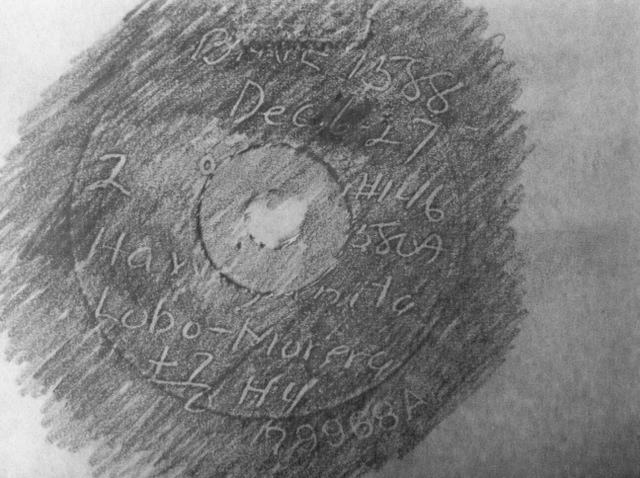
Anthony Baldwin writes: "I recently acquired HMV R14030, the Italian issue of Argentine Victor 79968: Hawayanita (BA1588) and Criollita (BA1589). Under the label of the Hawayanita side there is legible information scratched in the original wax by the engineer, notably the matrix number "BAVE 1588" and a precise recording date "Dec. 6..27".
Copy of original wax info at HMV R14030 - Hawayanita (courtesy by Anthony Baldwin)
"The "Hawayanita" side has legible matrix information scratched in the wax under the label, clearly dating the session to "Dec. 6. 27", whereas the date on the Oscar blog is "c. 10 December 1927". There is also a hand-inscribed "2" at 9 o'clock from the spindle hole, which would appear to confirm the die-stamped take number "2" in the wax run-off area. The flip side, "Criolitta", also bears the take number "2" in the run-off."

"In my view, c. 10 December 1927 was always a slightly dubious estimate, mainly because the 10th was a Saturday, a day when — in western culture, at least — musicians are usually busy working elsewhere. For similar reasons, the probably American engineer at Argentine Victor would have been used to the U.S. practice of working Monday to Friday: Saturday was for the racetrack or the golf course. Unless someone like Rachmaninov had been in town, I doubt that the engineer would have been amused to be dragged into the studio at the weekend — and certainly not for a couple of obscure guitarists!"

"It's interesting that the artist credit scratched in the wax is not to "Les Loups", but to Lobo-Morera [sic], presumably because Oscar was using his father's name, Moreira."

My comment regarding the last mentioned is that published sheet music from the period often credited Alemán by writing 'Oscar M. Alemán' - the 'M' could refer to his father's name, however, Oscar's middle name was another possibility. His full name actually read 'Oscar Marcelo Alemán'.
Sheet music frontpage - Hawayanita
Mr. Baldwin adds another interesting detail regarding the Victor session on Dec. 6th, 1927:
"Interestingly, the two matrix numbers immediately preceding the "Hawayanita" session, BAVE 1586 ("Caxorro") and 1587 ("Ya...Ya"), are by the Elio Rietti Jazz Band, apparently also recorded on Dec. 6, 1927. These sides are also both take-2. One wonders whether there was any connection between the Rietti band and Les Loups, or whether they were simply booked into the studio on the same day."

If someone can supply enlightening information of a possible connection between Les Loups and the Elio Rietti Jazz Band - a very popular and pioneering jazz band in Argentina in the 1920s, I should like to learn more. Contact me by using the e-mail below. Or use the comment facility of the blog.

Thanks a lot to Mr. Anthony Baldwin for his very informative observations!
---
Jo
keepitswinging.domain@gmail.com


Retrospect Keep Swinging (old) Oscar Aleman Choro Music Flexible Records Hit of the Week-Durium Friends of the Keep Swinging blog Keep Swinging Contributions

Monday, September 21, 2015

The 1948 Jazz Festival in Nice - #2

Georg Lankester continues and concludes his essay about the first International Jazz Festival of 22 to 28 February 1948, Nice (France). The text was earlier published in Dutch, here. 


Festival program 
American Overrepresentation
It was made clear from the beginning that the intent of Pananssié was to implement an American show, and as a consequence well known Frenchmen were missing. Think of musicians like Alix Combelle and André Ekyan, but also others. The only French contribution was the orchestra of Claude Luter, known for playing in the New Orleans tradition, greatly admired by Pananssié.

The co-organizers had a disagreement about the lack of French participation, but at the last minute was then decided to have Django Reinhardt and Stéphane Grappelli to join with their quintet as co-representatives of the French jazz .They would be on stage at the final on February 28th in the large ballroom at hotel Negresco, and the concert would be broadcasted by the RDF in the program "Nuit de Jazz”'. The musicians had to travel in haste by train from Paris to Nice.

Django was actually proud to participate in this international festival that presented so many Americans. The proof is that he later launched a composition with the appropriate title "Festival 48".

The Egos of the Two Star-soloists
Their performance would, however, be determined and no success ... the atmosphere between the two soloists was tense. There was still some rivalry between the two men which manifested itself in this festival again.

Django was in 1947 in top form. After his unsuccessful American tour he had fully recovered and was again asked for everywhere. Also in terms of recording it was a successful year in which he released several new compositions and played with various musicians in the studio. The guitarist made nearly 120 recordings, as I said, in many combinations. He surprised the world with songs like "Manoir de mes Rêves", "Crépuscule", "Artillery lourde" (following the war), "Belleville" and several other songs.


What Stéphane concerned, we must remember that he was in England at the beginning of the war. In England he performed everywhere and often with respected musicians like the pianists Arthur Young and George Shearing. He had become well known as a violinist and entertainer.

The two soloists were aiming to perform at this festival as major European jazz artists. They had thereby as accompaniment Joseph Reinhardt, Challin Ferret on guitar and Emmanuel Soudieux on double bass, so more or less a formation as in earlier times
Although at the beginning of the festival they still had some hilarious moments (see photo above shot during their arrival at the station), the mood inside was later determined tense.

A Lukewarm Reception
After the announcement of the Hot Club Quintet followed only a meager applause from the audience. This increased the tension between the musicians and especially Django was irritated. He wanted to hear that he was still the greatest guitarist. But Grappelli wanted to take the lead.

Unfortunately, it is unknown to me what repertoire was performed by the quintet on 28th of February, but there are preserved some private recordings (adapted from the radio), although of poor quality. The tunes are "Swing '42" and "Nuages". A rare and actually a historical document!


First is heard that Django plays an electric guitar and Stéphane is too far from the microphone. Everything sounds rough and you feel a  certain coldness between the musicians. We hear the countdown and then a strained Django, almost hesitantly, in "Swing '42". Because the guitar sounds much louder than the violin, the beginning is not a very harmonious duet. Django's solo sometimes exhibits bebop traits. Stéphane is in his improvisations too weak to be heard and does not seem stride. The ride off (twice the final strain of the melody) proceeds remarkable because Stéphane no longer is to be heard the second time through. Next follows an announcement of "Nuages" where the violin is barely audible and Django only comes to terms quite late. During the guitar solo there is a lot of buzz in the room. Then a few inspired solos by Grappelli accompanied by rough, almost violent chords from the guitar. The performance leaves an imperfect impression, not as in former times, and bad amplification worsens the audible output.

The reaction of the audience was significant. A barely audible applause was their lot and that was it! Afterwards Django's face showed some traces of despair, it was noted. The media were extremely critical and ruled that the quintet just repeated old routines and thus was not modern enough. Likewise ruled Boris Vian, who had been enthusiastic about the formation of the quintet in the past. He wrote in "Jazz Hot" that the guitarist was still the same and little had evolved in his playing!
All in all, a stark contrast to the traditional bands which received praise from the entire press that wrote plenty about American bands and particularly "Luter & ses Lorientais" was praised.

Yet the event still took a somewhat favorable turn for Django. He did the early hours participating in plenty of jam sessions of Americans including Louis Armstrong.

Further Setbacks and Restated Style Adaptation
Back in Paris, on March 10th at Studio Pelouze the quintet made a series of recordings, which can be said containing interesting titles, including the new composition "Festival 48". And there is certainly already a more modern style conception.


Then the musicians departed for England to give a concert in Hackney. But .... their instruments and personal belongings were stolen from the hotel. The rhythm section left them and was in a hurry replaced by English musicians. Django was pretty stoic during these events; Stéphane immediately bought himself a secondhand suit.
Their performance went significantly better than in Nice, which emerged from a review by the well-known magazine "Melody Maker". It reported that Django took everyone by surprise with very particular guitar playing and there were further bebop influences to be heard in Stéphane's improvisations.

Cautious Conclusion
Perhaps Dizzy's presence as well as the influence from other Americans in Nice had an effect on the quintet? The Jazz Festival in 1948 could therefore be considered as a (small) milestone for the quintet.
Hugues Panassié
And last, in the Hot Club de France organization came not long after the festival a final break between Charles Delaunay and Hugues Panassié, as Panassié kept focus exclusively on traditional jazz.

Georg Lankester
---
Jo
keepitswinging.domain@gmail.com

Retrospect Keep Swinging (old) Oscar Aleman Choro Music Flexible Records Hit of the Week-Durium Friends of the Keep Swinging blog Keep Swinging Contributions

Sunday, September 13, 2015

The 1948 Jazz Festival in Nice - # 1

The Nice Jazz Festival was founded by Hugues Panassié and lasted from the 22 to 28 February 1948. It featured a repertory of traditional jazz, swing, and bop music and was the first international jazz festival. Georg Lankester writes an extended essay about the festival. The text in Dutch was published earlier here, the second part in English will be published later.

A World Premiere

Hugues Pannasié
In early 1948, when the greatest misery of the war slowly faded, president of the Hot Club de France organization Hugues Panassié had the idea to organize a jazz festival from February 22nd to 28th (- immediately after the carnival) at the Riviera in Nice. He relied on the earlier success of the film festival in Cannes and the ideas of the committee which organized festivities in the city of Nice.

It would be an absolute premiere, for never before had such a festival occurred in the world. Even the Americans had not organized anything of the like.

But Pannasié's initiative, announced in the magazine "Jazz Hot", was primarily intended to get the traditional jazz into the spotlight. Because .... ..What was the state of art in Jazz? From the beginning of the 1940s had started a new jazz movement in the USA, the bebop. The swing was more or less on its peak.

Charles Delaunay
Secretary Charles Delaunay (whose efforts had resulted in Django Reinhardt’s fame) was particularly fascinated by the new style, unlike Panassié. Even Django liked all modern. There was thus already registered the start of a conflict within the Hot Club de France organization.

While Panassié’s festival was sponsored and musicians like Louis Armstrong with his "All Stars" band had been invited, as well as other greats like Earl Hines, Barney Bigard, Baby Dodds, Jack Teagarden, Rex Stewart and Mezz Mezzrow, Delaunay contributed with 17 men counting on the orchestra of Dizzy Gillespie to participate. Bebop trumpeter Dizzy was shortly before the festival invited by Delaunay and now arose among jazz fans two camps: traditional or modern jazz.
Dizzy Gillespie, 1948
Before he came to France, Dizzy was dogged by bad luck. In Paris, he gave a series of concerts at the famed Salle Pleyel. But Panassié, who attended the first concert, was extremely negative and stated that this was not jazz. On subsequent appearances there were clashes between supporters and opponents and even the gendarmerie had necessarily been involved.


In the month prior to the Festival, Django Reinhardt played in the ABC theatre, near Les Halles. Dizzy went there one night after his performance. He found the guitarist along with bassist Emmanuel Soudieux. Django was positively surprised, because he had already met the trumpeter during his visit to America in 1946 and the two musicians had become good friends and admired each other.
Dizzy Gillespie & Django Reinhardt
Spontaneously that night resulted in a jam session which Soudieux remembered how great both musicians played and exchanged turns and what a pleasure they experienced doing it.

Delaunay also arranged a concert for Dizzy in Marseille plus - as mentioned earlier - participation in the great jazz event in Nice.

Festival program
Jazz and Entertainment

Now something about the actual festival: To maximize the attraction of the public to this event there had been reserved rooms the first day where could be danced to the music of famous orchestras, while later that week could be attended concerts.

Hotel Negresco
It was mainly the Americans who entertained dance lovers in the large halls of the Hotel Negresco. But afterwards several band members joined - to the delight of many Frenchmen - jam sessions in other places, i.e. "Monte Cristo" or "Christies". Well known American musicians were treated with admiration and with all respect by the staff at Negresco. Especially the drummer of Armstrong's orchestra, Sidney Catlett and vocalist Velma Middleton led to the astonishment of the Negresco staff when ordering the most expensive drinks and meals at 4 o'clock in the morning.
Hotel Negresco: l-r: Louis Vola, Barney Bigard, Django Reinhardt, Earl Hines, Stéphane Grappelli, Sidney Catlett, Arwell Shaw
And there was, of course, enormous attention and praise for Satchmo and to a lesser extent, the famous French artist Boris Vian. Nice to say is that among the celebrities were also young European jazz musicians like Humphrey Lyttlelton and Toots Thielemans, who - as we know - later would make great furor.

During the "Nuit de Jazz” there was also a "Tour de Chant" with French singers Yves Montand, Suzy Delaire and coming from Nice Henri Betti; all naturally attracted extra crowds. The hall offered for this event for 600 visitors claimed 5,000 francs for each seating.

Georg Lankester

--- 
Jo
keepitswinging.domain@gmail.com


Retrospect Keep Swinging (old) Oscar Aleman Choro Music Flexible Records Hit of the Week-Durium Friends of the Keep Swinging blog Keep Swinging Contributions

Sunday, September 6, 2015

The Classic Banjo

Hans Koert (1951-2014)
It has now been a year since my good friend and originator of the Keep(it)swinging website, underwebs and blogs, Hans Koert, passed away on September 4th, 2014. Before it was too late, Hans asked me to take over and continue his work, which I promissed and am honored to do although it has been quite a challenge to cope with Hans' tempo and enormous knowledge about the music and related subjects he loved and was always willing to share his experience of with others, who had the same interests. The regular visitors and readers of the Keep(it)swinging domain know what I am referring to and new readers have the opportunity to explore the many articles and blog entries that Hans published using this survey of accessible subjects, here

CD front, Classic Banjo from Smithsonian Folkways (SFW 40209)
Among the many subjects and items I had the opportunity to share with Hans was the shown anthology CD from Smithsonian/Folkways released in 2013 (- more info here).  This great compilation of American banjo recordings has many fine examples of the various styles attributed to the term The classic banjo from recordings in the Smithsoninan/Folkways archive and the album was also well received by both connoisseurs and critics (- a review is accessible here). However, by setting focus on the classic banjo I was disappointed to learn that the anthology primarily presented examples of American styles rooted in regional folkmusic, while the popular repertoire represented by the great ragtime banjo players like Vess L. Ossman and Fred Van Eps a.o. was not covered by this CD. Moreover, the term Classic Banjo seems to be limited to American musicians and tradition by the producers of the CD although there exists a tradition outside the USA and talented players from other regions of the world, who also should be acknowledged for evolving the classic banjo playing. - Here I'll insert some examples from the compositions by Joe Morley to extend the picture.
Joe Morley (1867-1937)
From a short profile at the Classic Banjo website, the following is stated about Joe Morley (1867-1937):

"While the banjo is acknowledged to be an American instrument, it took the British to write some of the best music for it. Without argument, Joe Morley was not only the most famous finger-style player but also one of the most prolific of composers, having published nearly 200 pieces in his lifetime. His compositional style ranges from delicate gavottes to rollicking, banjo-swinging romps. He toured widely and played regularly on BBC radio. His distinct style is marked by the constant use of triplet figures and often driving, syncopated rhythms. Unfortunately for Morley, he sold many of his manuscripts for paltry sums of money to help finance his gambling habit. He was virtually penniless when he died." 
- A website devoted solely to the life and legacy of Joe Morley is available here 
William J. Ball (1915-2000)
Fellow countryman William J. Ball is considered one of the finest interpreters of Joe Morley's compositions. Learn more about William J. Ball here.  YouTube has several examples of Mr. Ball playing compositions by Joe Morley, below I'll insert some of them. - Here is first William J. Ball performing Morley's Palladium Rag 


Next, here is a performance of Joe Morley's Mr. Punch 


The following is William J. Ball's performance of Joe Morley's Freckles 


Finally, to end this small contribution on Classic Banjo, here is William J. Ball's version of Joe Morley's London Club Parade - enjoy!


More info on the Classic Banjo tradition in Great Britain is available here  
---
Jo
keepitswinging.domain@gmail.com

Retrospect Keep Swinging (old) Oscar Aleman Choro Music Flexible Records Hit of the Week-Durium Friends of the Keep Swinging blog Keep Swinging Contributions